


The shock of Israel
My second move abroad.
I learned Hebrew. For a year, in Tel Aviv, I attended ulpan four days a week, for five hours a day (ulpan is an intensive Hebrew-language programme for new immigrants). This year of learning was also a year of going out, meeting people, and enjoying myself in a city that truly never sleeps. People say New York is the city that never sleeps. Well, having spent time in both, I assure you that Tel Aviv beats New York. Perhaps that’s because the area where everything happens is much smaller in Tel Aviv than in New York. You don’t need a car to get from one place to another. Everything is walkable. And it truly never stops.
Tel Aviv also felt far more international to me than New York, Paris, Barcelona, Los Angeles, or Miami. This is due to the constant influx of new young immigrants arriving from everywhere, especially people making aliyah (the immigration to Israel offered to Jews anywhere in the world). And it was this international environment that made me feel “at home” at the beginning. I knew many more foreigners than Israelis.
At the end of my first year in Israel, I met the man who would become my husband. He was Israeli, of Iraqi descent. His parents had fled Iraq in the years after the Second World War, like so many Middle Eastern Jews at that time. I didn’t know it, but in those countries too, the war had deeply disrupted Jewish lives. For many, leaving was not a choice, but a matter of survival.
Israel was built by successive waves of immigration and refuge. People from remarkably different cultural backgrounds had to find ways to live alongside one another, often with only Judaism as a shared reference point. But the mix of cultures around this single common point was impressive.
The man I met spoke English well, was not religious, and traveled a lot. He was also free-spirited, very generous, and very determined to court me from the moment we met. After a few weeks, I met his family. I was very well received. They were relieved to see their youngest son finally entering a serious relationship. In their social world, being unmarried and childless after 30 was far less common than it was in the Netherlands.
Two different worlds
But behind this warm welcome, there was already, without me seeing it, a whole world of differences.
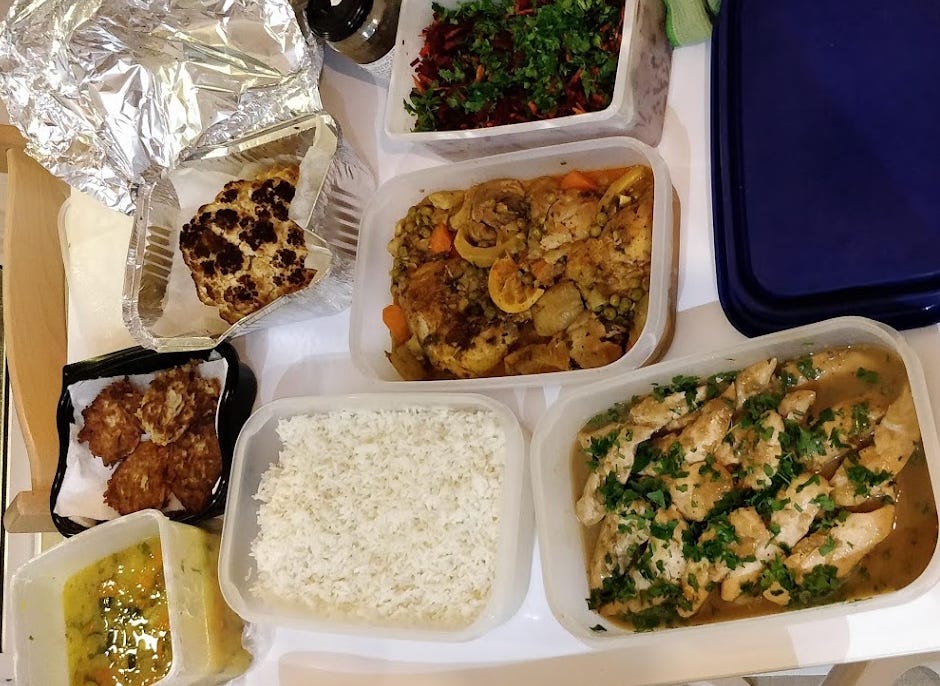
In his family, closeness took forms I wasn’t used to. We got together very often, his father would go to the market and distribute his finds, especially the fruits and avocados. His mother would make five to seven different dishes for us each weekend, during their now-routine weekly visits. I never had to cook: the freezer was full of containers. I even found a photo of it.
Many people told me I was lucky. But I struggled to find my place as a mother in my own home. One day, I finally wanted to say, “That's enough, thank you.” so I gently asked her to stop cooking for us. She replied that it was either that, or she would not come anymore. Her son told me:
“Accept what she brings and throw it away!”
I was shocked! No, I couldn’t do that: I can’t stand the waste of resources…
That’s just an example. I arrived carrying my own deeply European assumptions. The idea that you ask for permission before entering someone’s life. A sense of time that is more linear and more individual: you plan, you give notice, you respect the other person’s space.
For them, time belonged to the family before it belonged to oneself. Friday night was almost always spent with the family, and refusing the grocery bags and the containers of prepared food was received as a rejection. I know it wasn’t an intrusion to them. For them, it was love. For me… it felt like I was losing myself.
Their particular hospitality, rooted in a history and culture I was still learning to understand, was a kind of generosity that felt impossible to refuse: they serve you, again, and again, and saying no is never enough. It took me years to understand that it wasn’t inappropriate insistence, but a way of loving that I didn’t have the codes to read.
I didn’t want to see it at the time. “Love is blind,” as they say. Well, yes. I admit that has been very true for me here. I could have seen many signs that were screaming “Don’t go there!”, but I didn’t. My lovestruck heart, no doubt my age too (I was 36, “the clock,” as they say…), and the desire to become a mother myself, or simply the fact that he was really planning a future with me: a bunch of reasons not to listen to the voice of reason.
Beyond language.
That is where the Note from Fred caught my attention (the one that sparked the desire to share my experience). It reminded me how much culture matters for understanding one another. I didn’t even imagine it existed like that, that it could be a wall. I spent years thinking the problem was me, my imperfect language, my insufficient efforts.
But the problem wasn’t effort or language.
The problem is that a language is a door, but culture is the house. And you can go through the door without ever living in the house.
I could understand the words but I could not grasp what passed between us in the silence between two sentences. The unspoken. The way a laugh stops. What a sentence opens and closes without saying. The nuances.
The main lesson is that deep understanding does not play out only in words, but in invisible codes: habits, expectations, the relationship to time, to family, to space, to silences, and to boundaries.
▸ A language is a door. Culture is the house.
The man who heard the words
And then I think about my ex-husband. Because there, the wall wasn’t even between two cultures. It was between two people who, however, spoke the same language.
I tried to explain to him what I was discovering: the unease growing inside me, and the growing sense that I did not resonate with the culture around me. What it feels like not to be home, and not to feel at home. I tried to make myself understood when I did not yet fully understand myself.
Even today, he brings back things I said. He has a good memory, I have to give him that. He repeats sentences from that time almost word for word. And each time, I feel I have to explain myself all over again. Because what he retained was not quite what I meant; it was his understanding of what my words meant.
You can be two people, get married, share a life, speak the same languages, and yet, deep down, not speak the same language.
It’s not a question of food or flags. He was never an “expat.” And so, perhaps the distance between two people can be greater than the distance between two countries.
▸ You can get married, share a life, and not speak the same language.
Understanding each other doesn’t mean talking more. It begins when we accept that the same words do not always carry the same world.
←Read the first part.
The final part will follow soon.
By Audrey ✨, founder of The Aligned Shift, an editorial house with two doors: Correspondences | The Aligned Shift Magazine for texts, and Words of Shifters, the podcast, for speech.
Do you accompany others?
I would love to read or hear you here. Over time, your presence in the house earns you a profile page on thealignedshift.media: a page in your name, linked to your texts, where people looking for a practitioner can find and contact you. It cannot be bought or requested; it is earned through presence. More visibility online, so a better chance of being found by people who search through AI agents.
Call for contributors: what if your future clients met you before choosing you?

Are you a practitioner helping others shifting lives?
Bonjour Audrey,
Comme je te le disais, ton témoignage m'a beaucoup marqué en particulier cette idée qu'une langue est une porte mais que la culture est la maison. Je m'en suis inspiré pour écrire un article dans ma newsletter, La Lettre de Wens, en le mettant en résonance avec mon propre parcours entre la France et le pays Dagara.
Avant de le publier, je voulais te demander : es-tu d'accord pour que je te cite nommément (avec un lien vers ton travail si tu le souhaites), ou préfères-tu que je garde ton témoignage plus discret, sans mention de ton nom ?
Dis-moi ce qui te convient le mieux.
Honnêteté et Sincérité,
Wens